UBS · CASE STUDY 02
Twint integration
6M+
Active Twint users in Switzerland
~1bn
Twint transactions in 2025
70
Participants in the study that validated the direction
56%
Favourable from first exposure
COMPANY
UBS / Twint AG
ROLE
Sole Product Designer
TIMELINE
2020 — 2024
TEAM
1 PM, 1 PO, 1 BA, developers in Switzerland and Hungary, Twint AG as vendor
CONTEXT
Not a bank product. A shared platform, deployed as ours.
Twint AG is Switzerland’s leading payment platform, co owned by the country’s major banks including UBS, with over 6 million active users and nearly one billion transactions in 2025. It is not a bank product. Each bank deploys it as their own branded app, carrying their logo and UI, but built on Twint AG’s infrastructure. UBS had negotiated broader customisation rights than most banks. A separate app per bank is the Swiss market standard, not a UBS choice. At the time, no Swiss bank had P2P integrated into their main banking app.
MY ROLE
Sole designer, two squads, four years
Sole product designer on UBS Twint from 2020. In earlier years, junior designers worked under my direction on execution and exploration; I led all stakeholder engagement, design decisions, and strategic direction. From 2023 I covered both UBS Twint and UBS Mobile Payments as the sole designer across both squads.
The environment had no shared design system, a development team in Hungary with little prior experience working with designers, and stakeholders who routinely made product decisions without design input. Getting design properly embedded in the delivery cycle took sustained effort over several years, including restructuring the collaboration model with the PM toward a more agile approach with fixed UX checkpoints.
Twint AG, as the external infrastructure provider, defined the core product direction. Our scope was adapting their product and brand to UBS’s regulated banking environment, within the limits of UBS’s negotiated customisation rights. The design work covered the full product surface: P2P flows, QR scanning, partner offers, notifications, alerts, confirmation screens, security flows, and onboarding.
THE PROBLEM
The existing app was already failing
By the time I was working on UBS Twint, the model was breaking down across several dimensions at once. The app ran on a completely different design system from the main UBS banking app. Components were missing. The design library had no coverage of key patterns. There was no structural consistency with UBS’s core product, and the gap was widening with every release. Without a shared foundation, every change required custom work: slower to build, harder to maintain, and increasingly painful to release. Development was not just slow. It was becoming structurally impossible.
A single app for all banks
UBS’s customisations were adding friction to the release cycle, slowing UBS’s own delivery and adding delay to Twint AG’s broader roadmap. The direction was clear: less room for bank specific product, more pressure toward a single consolidated experience across all banks. An early internal response to that pressure did not hold up. It paired the Twint AG login screen with UBS branding, added promotional banners unrelated to payments, and left out the UBS design system entirely, on infrastructure that was already struggling.
THE STRATEGIC CASE
Retire the app. Build Twint into the bank.
I had been developing an alternative proposal in parallel for some time. When I saw what Twint UBS and Twint AG were proposing together, I raised my concerns with the team (PO, PM, BA) and presented my own direction. It was dismissed.
My proposal: retire the standalone UBS Twint app entirely and embed Twint as a native widget inside UBS Mobile Banking, with all existing functions, from P2P transfers to QR payments to partner offers, available within the banking app itself. No separate download, no separate account, no parallel design system.
I benchmarked how major banking markets had addressed the same problem. The pattern was consistent: P2P payments had been absorbed as a native feature of the main banking app. Leading banks internationally, particularly in markets with high payment adoption and strong digital infrastructure, had chosen integration over a parallel product. Switzerland’s per bank separate app model was the outlier, not the standard.
I produced draft designs across the full integration: widget placement, login screen entry points, icon concepts, and key interaction flows. I did not think the joint proposal served users, so I brought my alternative to the head of mobile banking, on the business side.
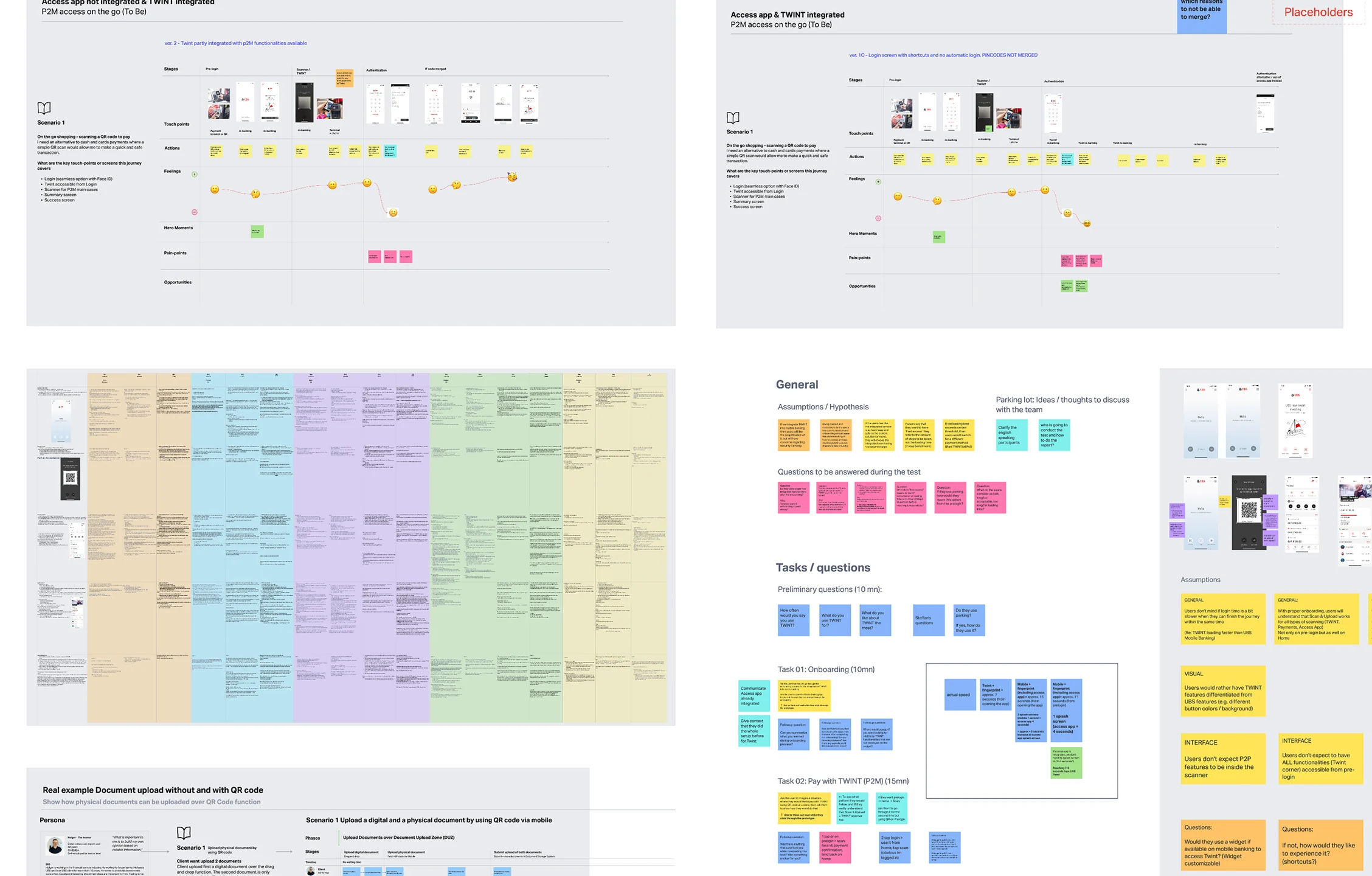
Bringing Twint into UBS Mobile Banking, from research to strategy.
THE OUTCOME OF THE PITCH
The direction that held
Showing my proposal to the head of mobile banking sparked discussions across UBS and Twint AG. The head of mobile banking agreed to follow my direction and reject the joint version. With that direction confirmed, we built the management case together: the head of mobile banking provided organisational reach and sponsorship, I provided the research, the designs, and the rationale. The proposal went to management with the head of mobile banking as champion.
We validated the approach with 70 participants, combining qualitative sessions and a quantitative study, before any build commitment. As part of my proposal, the login screen entry point was designed to solve two frictions: authenticating into UBS Mobile Banking took longer than Twint’s standalone flow, disproportionate for a user base that mainly sent money in seconds, and some users were reluctant to expose their full banking environment, including balances, on screen. Testing confirmed both: a clear majority favoured integration, with or without the login entry point.
Full integration was ultimately judged too large a step for the immediate roadmap: the backend changes were substantial, and the investment case was not yet in place. Instead, the middle path was to retain a separate UBS Twint app, rebuilt properly on the UBS design system, with reusable components and structural consistency with the main banking product, as the foundation for the full integration to come.
The rebuilt UBS Twint app, aligned to the UBS design system, removed the technical case for a single consolidated app across all banks. Twint AG abandoned the initiative. Full integration remains the direction, but the login and backend work it requires is substantial and still underway. In the meantime, UBS Twint continues as a standalone app, now rebuilt natively on the UBS design system, as the foundation for that longer transformation. The dedicated team formed for this work is still active today.
Prevented a damaging product launch
Direction validated with 70 study participants before any build commitment
UBS Twint rebuilt on the UBS design system, with reusable components and structural consistency with the main banking app
Twint AG’s push for a single consolidated app across all banks made far harder to justify
The consolidation initiative was eventually abandoned, and UBS retained a differentiated product
A dedicated team was established and is still active today
IN THEIR WORDS
Users said it plainly
“Having to jump between UBS Mobile Banking, Access, and Twint just to send money is nerve wracking.”
“I’d love to have everything merged into one app instead of switching between three.”
“I just don’t want people seeing my full balance if everything’s merged, that’s the only thing holding me back.”
“I use Twint constantly, but I still open UBS Mobile Banking just to check my balance before sending anything. I’d want it all in one place, as long as it stays private.”
“Send, request, parking, paying at partners, that’s really all I use, and it’s simple and instant, which is why it works.”
“I wish I could use it when I travel. My account in another country already has peer to peer built into the banking app, so it feels odd UBS keeps it separate.”
“I like Twint, but I wish it didn’t keep pushing ads and offers every time I open it. I just want to send money.”
THE DESIGN WORK
Built on the UBS library, not alongside it
The central decision was to build everything on the UBS design library, not alongside it. The goal was not consistency for its own sake but eliminating the customisation debt that had made every release progressively harder. Components built once, to UBS standards, reusable across cycles. That was the structural discipline the product had never had.
Where the design system had no coverage of Twint specific patterns, we built it. The principle: no custom component without clear justification. Anything that could use an existing pattern did. That constraint required consistent enforcement through design reviews, particularly against a development team accustomed to resolving ambiguity without design input.
The brand mapping required a deliberate decision for each component: where Twint’s visual identity applied and where UBS’s took over. Twint retained its character where users expected it. The line was set intentionally rather than resolved screen by screen.
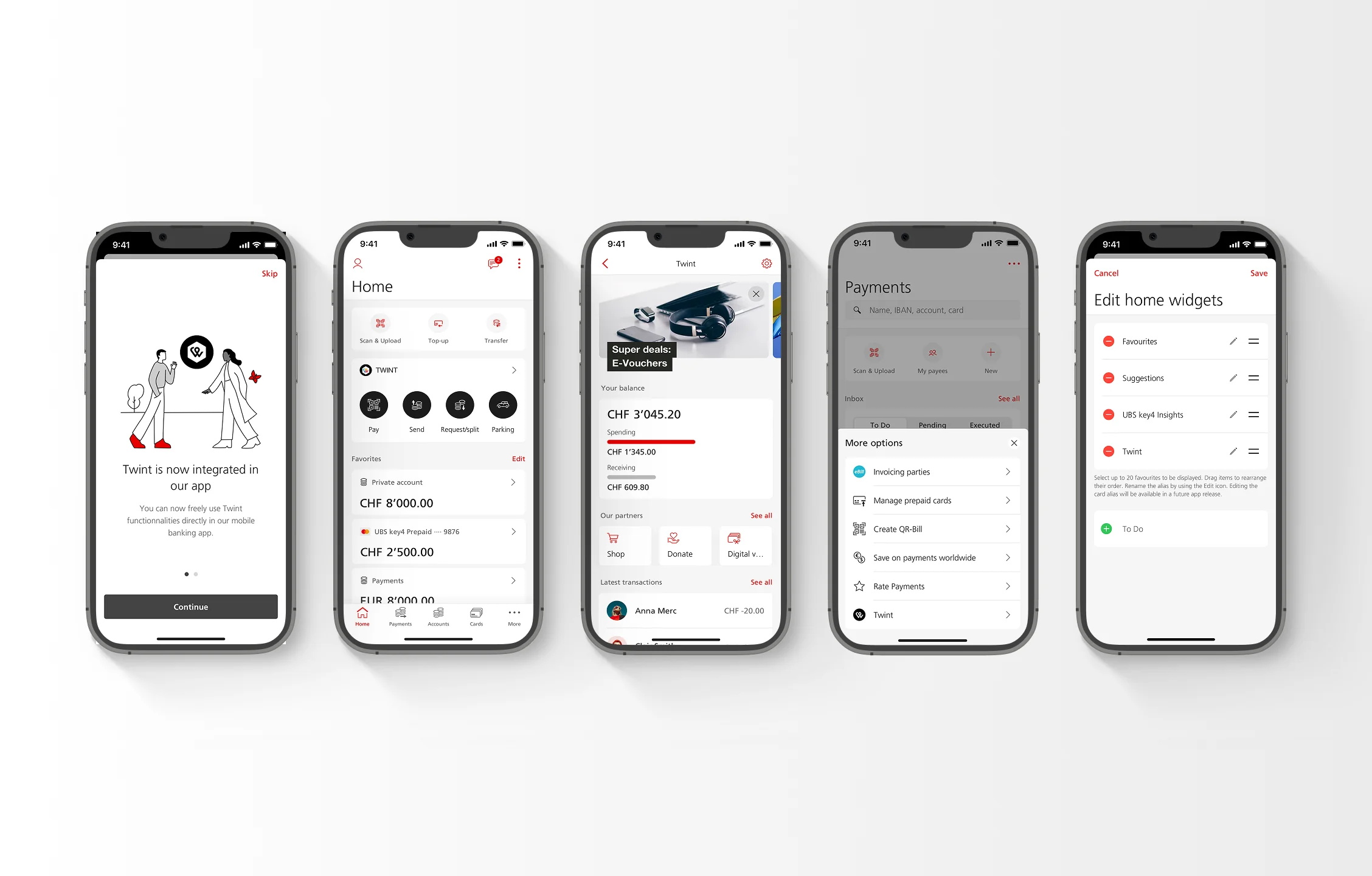
An extract of screens from the proposal presented to management, the concrete design direction that got the rebuild approved and shaped the version that shipped.
RECOGNITION
Promoted to Associate Director
The promotion did not come from delivery alone. It came from challenging a direction the business had already committed to, proving a better one with research rather than opinion, and turning that into measurable quality the business could build on. Together with the years of work behind it, that is what made the case to senior management. In 2023 I was promoted to Associate Director.